THE PATH NOT TAKEN
So - it's only a ballad. But the voice is limpid (she could belt it out too when needed), you can hear every word, and the feelings expressed seem to articulate sympathetically the thoughts of a girl in one of those minuscule catastrophes which afflict the young. In any case, listening to any of the current chart-toppers, if you can get close enough to distinguish the words you will find that they are often merely sloppy sentiment disguised by a lot of bashing and strumming.
Why has so much of society rejected all tender feeling in favour of arrogant violence? Is our world really so much of a jungle that only harsh loud mindless noise can express it? Or does the constant outpouring of thumping banality induce this terrible insensitivity in the hearers?
For once, my ancient wisdom fails to see any answer to all this.
Friday, February 08, 2008

Friday, February 01, 2008

Sunday, January 13, 2008

Thursday, November 08, 2007

WINTER JOY
The clocks have gone back, the shops are already full of twinkly treasures, and the winter season clothes catalogues arrive on the mat.
And what a feast of colour they offer us! I quote from but one edition -
'Slate, Anthracite, Shale, Navy, Dusk Black, Dark Spice, Ivy, Dark Charcoal, Dark Brown......'
Never mind, the girls will be wearing cheerful wintry colours!
These are the girls' colours. Men are offered an even wider range of glumness -
' Blackberry, Hickory, Mahogany, Midnight Purple, Dark Earth, Iron, Hematite, Deep Lake, Dark Indigo, Dark Forest.....'
'Gone into mourning, one might imagine, for the death of the sun.' Why do we allow ourselves to be cowed into accepting whatever the rag trade decide is 'in this season'?
I tried to buy a short mack for the winter. My favourite outfitter could produce just the thing - in a shade I can only describe as frozen spinach past its best. 'Another colour?' 'I'm afraid they're all like this at the moment, sir.' So look forward to grey streets filled with trudging figures wearing boggy garments this winter, just when we could do with a bit of cheering up.
Of course, when it gets really cold........

Wednesday, October 10, 2007
HOW TO LIVE WITHOUT SPENDING ANY MONEY


For some time now there has been growing concern that the British economy is becoming more and more dependent on vast amounts of credit card lending. For some people, resort to a credit card loan may be the only way to negotiate a really serious temporary financial problem, and even then it must be obvious that they are only postponing the day of reckoning.
But I suspect that putting more strain on an already stretched credit limit is too often a way to obtaining glittery 'must-haves' rather than to relief of any real necessity. The idea that if you can't afford it then don't buy it seems to have been relegated to the area of quaint old discarded things, like badger shaving brushes, hip baths, and pince-nez. So we have built up a vast filigree of interconnected debt, where it only needs a crack in one part to bring the whole over-strained edifice to the ground.
Few people read nowadays, and history is a bore; otherwise the phrase 'South Sea Bubble' might bring a chill of common-sense across the hearts of those who contemplate going down the path of easy credit. But the card companies are themselves largely to blame. Each month our credit account announces cheerfully 'You have £15000 to spend'. This is rubbish, and lying rubbish at that. We have got nothing. It merely means that they will lend us this much at an extortionate rate of interest. We know that we should be mad to spend in this way: the card company know this as well, but they are perfectly willing to encourage us to do so if it will increase their turnover, and have no sense of their reponsibility to offer sound advice to their customers.
It might be possible to deal with this by legislation. Insurance and investment firms are required to use specific phrases, point out possible problems, and offer let-out clauses. There seems to be no reason why similar disciplines should no be imposed on credit card offers. But few punters wish to read the small print, or are capable of understanding it when they do. Anyway, perhaps the false image of a booming econmy is too precious and fragile for any government to wish to send a ripple of common-sense through it. In the meantime more and more naive people are moving steadily into a financial situation hopeless both for themselves and for the economy as a whole. One can only watch with fascinated horror. The pleasure of saying 'I told you so' when the inevitable crash comes will be very meagre.
Monday, September 24, 2007
ENGLISH LANGUAGE - AN ENDANGERED SPECIES [2]
English has spread widely as an international language, partly because of American global dominance, but mainly, I think, because it has rid itself of a lot of fiddling details that still bedevil other languages. It is not cluttered by diacritical marks, umlauts, accents, cedillas, and the like. It is rarely bothered by gender, whereas in European travel your French feminine shirt is suddenly neutered as you pass into Germany. It is possible to speak faultless English while remaining blissfully ignorant of the subjunctive (though old people sometimes like to play with it as an intellectual exercise).
On the other hand it has a number of ineradicable disadvantages. One is its irregularity of spelling and pronunciation - the 'cough, bough, rough' syndrome is frequently held up to scorn by rivals. Another is its unwillingness to abide by any set of rules - the moment you have sorted out a clear mnemonic the exceptions come crowding in. All the more reason, then, to cling to whatever basic principles can be established.
Take the simple word 'cover' for example. (Pronounced 'kuvv-er', for those of you in the back row.) Characteristically for an English word it has an array of uses. When we put the lid on something we 'cover' it. What we put on it is a 'cover'. The item is then 'covered'. When we take the lid off we 'discover' what is underneath. We tell the world of our 'discovery'. On the other hand if we 'uncover' something we hint that we have found something a bit shady - under-cover. With luck we may 'recover' the stolen goods that have been hidden by the thief. (But notice the subtlety of the language - 're-cover', with the hyphen written or implied by intonation, is something you do only to books, armchairs, and the like.) All this is connected to the basic word 'cover'; and once a newcomer to the language has managed to grasp that we are in the same league as 'lover' (but not 'hover' or 'Dover') then all is plain sailing.
Why on earth then do some people suddenly introduce a different pronunciation? An alternative (older) version of the adjective is 'covert' - still meaning 'with a lid on', and pronounced 'kuvvert'; still intimately connected by pronunciation and meaning to our basic 'cover'. Secret operations are carried out under cover; they are therefore 'covert'. They are carried out 'covertly'. If you happen to be a small wild animal being pursued by red-jacketed men with dogs you may seek cover in a covert, a patch of dense foliage. The owner of the land, in the days when men still wore overcoats, might sport a covert coat, a short overcoat suitable for tramping through the undergrowth covering the covert. If he bred horses he would have his own technical use for the word.
All this richness of language is organised under the word 'cover', and we do language a disservice if we deck it out with fancy pronunciations which seem to indicate that 'covert' is just any odd word that happened to be lying about so we grabbed it. And we make the language just that bit more difficult for the newcomer.
None of this has anything to do with 'cove' [COEv] - a curved inlet in a coastline (or a rather disreputable figure in an Edwardian novel).
But just as you think that it's all very easy really, notice the Cornish village of Coverack - pronounced not 'kuvver-ak' but 'cov-rak'. Ah, well.
Saturday, September 22, 2007
ARLINGTON COURT
Arlington Court is a National Trust property on the western edge of Exmoor. The house itself is lumpy externally, but rather splendidly domestic inside. The grounds range from a Victorian formal garden to tracks through the wilder bits of the estate, including a lake.
There is a very fine collection of horse-drawn carriages of all kinds, housed in a special block of the stables, and visitors can take horse-drawn rides at a sober clop round the grounds. However, I caught the equipage just after the last amble of the day, when the horses were travelling light on their way back to the stables.
Tuesday, September 18, 2007

CAN YOU EXPLAIN BEES?
It is a warm day. We sit in the conservatory, with all windows and doors open. A bee blunders in. He decides he is in the wrong place, and hurls himself at the nearest window. He seems baffled by the fact that he cannot push through the glass. However, he determinedly chooses another window, with the same result. And another...and another...and...
What he never seems to do is to fly out through the wide-open door, even though he sometimes flies right past it. Eventually, when he is reduced to a quivering bundle on a window-ledge, I take pity, scoop him up, and release him into the outside world, where he seems to fly off with relief.
How is it that an animal that is bright enough to be able to build a honeycomb based on angles of 120 degrees (a task that would baffle a lot of our children) seems unable to understand that open doors work both ways?
Thursday, September 06, 2007

ENGLISH LANGUAGE - AN ENDANGERED SPECIES [1]
I had the tremendous advantage of having been born into the golden age of broadcasting. It was technically primitive - we listened to an unamplified signal through headphones, and if anyone turned over the newspaper the message was momentarily drowned.
This side of things improved quite quickly, but it was still John Reith's BBC we heard. This had its absurdities; the most remembered I suppose being the rule that news readers had to wear dinner jackets. Sundays were drear, with a great bias towards propagating the faith; and commentaries on current events, always with a proper respect for the (usually Conservative) government, tended to be delivered in the kind of hearty condescending voice that was before long to be heard making encouraging noises about the British war effort on news films.
What we heard, however, was generally the King's English - a form of lingua franca among the educated. There were some things wrong with this concept, particularly because it seemed to perpetuate class distinctions which many of us wished to see toned down if not eradicated. But it did represent a way of thinking and expression which was distinguished by a sense of clarity, a width of reference, and a delight in the sheer pleasure of employing a skill which had produced, and could still produce, melodious trenchant utterance. I don't know that we ever consciously imitated this style, much less made any attempt to learn it, but it did echo in our ears, and we absorbed it through the pores. [Not all radio influence was good, though: I remember Miss Winnington Hill, Head of English, fighting a despairing battle against a popular song of the time with the refrain 'Any umberellas, any umberellas...'] Still, if we did not always know how to speak, it was a comfort to know that out there were people who did, and that for the first time in history such speech was easily available to anyone who cared to listen.
Not so now. Half the population does not know how to speak, and if anyone listens to radio or TV he will hear a rag-bag of usage which has neither rhyme nor reason, and is no help at all. The heir to the heir to the throne speaks in a kind of suburban mumble: small hope for the King's English there, then. But it might yet be possible to insert a little discipline into the use of our precious language by the application of some clear thinking. Otherwise we shall continue to hear university professors who are happy to contrast the situation in Grea' Bri'ain with that prevailing on the Con'inen'. So here goes - a still small voice.
People Who Do Things
English is good at making a word adopt all sorts of useful functions. So you can say 'I can't stand this heat', or 'Heat the milk first', or 'Gas heater', or 'Use low heat', or 'He became quite heated', or...... But you need to adapt the right word in the first place.
Take a company that conTRACTS (verb) to do a job. It is a conTRACTor (noun). The fact that in this case there is another noun for the CONtract it has signed does nothing to stop its being a conTRACTor.
People who join in a PROtest (noun) wish to proTEST (verb). They are proTESTors. You take your name from what you do, not from what you're interested in.
So, subSCRIBers, not SUBscribers. And reSEARCHers, not REsearchers, and.........
Generally, people or things that do things are stressed on the second syllable [ti-TUM-ti]. There are oddities. What you do to food is to PROcess it. So you whizz food in a PROcessor. Since it is possible to proCESS - to walk in a procession - you would expect a person taking part in it to be a proCESSor, but he isn't, he is a proCESSioner. Though a person who proFESSes a particular skill is a proFESSor.
But then, I never promised it would be easy, did I? Think of it as a kind of mental jogging. Anyway, if you will promise to stop talking about CONtracters, and SUBscribers, and PROtestors, and CONtributers, and........ we shall have between us scrubbed the English language clean of some obscuring fungus.
More to come.
Wednesday, September 05, 2007


So we have had what many of us hope is the last of the Princess Di weep-ins. Of course one is saddened by the loss of a young and vibrant life in sordid circumstances, but it was a story she chose to live in, and the situation is by no means as clear-cut as her mourners seem to suggest.
Clearly Charles dithered over his relationship with Camilla until it was too late. Obviously, then, he had to be offered the solution usually adopted in such circumstances, of the Royal Personage being allowed to keep his true love as a discreet mistress, while being paired off with a suitably nubile partner for official breeding purposes in order to maintain the line. Nobody is going to object to that, unless one happens to be the kind of starry-eyed fantasist who believes that all members of the royal family are by nature noble, and that it is the function of the aristocracy to lead us lower orders in the paths of righteousness.
So, what went wrong? Can we really be expected to believe that a sweet young princess was decoyed into a sophisticated and cynical world totally beyond her comprehension? Certainly her father must have known what was going on, and even if his self-satisfaction did not allow him to give her sound advice before shuffling her up the aisle it has long been common knowledge that her mother, who had got out of the family situation much earlier, warned her strongly to re-consider. Besides, young as Diana was seen to be, she was no simple milkmaid from a fantasy country idyll. The manipulative ogling that was displayed as the marriage fell apart had not been learnt in a few months, nor the ease with which she consoled herself afterwards with glitzy company and fast cars.
The whole Spenser family made a risky investment offering rich returns, and, as many of us simpler souls are aware, if you do that the chances are that you will end up badly burned. That one of those involved was an attractive young butterfly who was eventually scorched to death is a cause for quiet sorrow, but not for sanctification.
And the royal family? They are by education and tradition case-hardened to events such as these, by no means unique in the rough island story. From the Queen down, they were prepared to ignore the whole sordid affair once it was over. The hysterical outburst of sentimental public opinion which followed forced them to engage in ritual gestures of sorrow. I doubt very much whether it has much endeared them to the great soft-centered British public, and will certainly not have endeared her subjects to the monarch.
Tuesday, September 04, 2007

MORE DESTRUCTIVE DIRECTORS
I complained on 22 March of the antics of foolish stage directors, perhaps with a half sense that this was yet another sign of the daftness of the contemporary world.
I am relieved in some ways to have come across a reference to Alec Guiness's production of Hamlet in the 1960s, in which Ken Tynan, playing the Player King, was required to wear a large false plastic ear for Lucianus to pour the poison into, for all the world, as Tynan put it, as if it were 'an advertisement for a proprietary brand of rum'. So arrant stupidity is not, after all, a characteristic of directors of the twenty-first century only.
There seemed to be more point, in a production in which I was involved, in putting the Players to act in half-masks, to detach them from the real world. The only snag from my point of view, in this and other productions, has been that actors always want to keep their masks as souvenirs, so that I have no reminders of all the work that went into designing and making them. In this case I put Lucianus into black and silver, corvine, with a laid-back plume, and Prologue into scarlet and gold, cocky, with a tuft on top, rather, in retrospect, like a cross between a cock and a hooded kestrel (a coistrel ?- see Twelfth Night)
The two lads playing the parts could not agree who should wear which, so they ended by changing parts each night. I can't remember who took home which, but certainly I never saw them again. So eventually I had to make a set of display masks for an imaginary ballet of the Four Elements to put up at home. The picture, in case you have been wondering what it had to do with directors, is such a mask, for Water, shown only in the hot dry months of summer. Perhaps it has been performing a rain dance.
Sunday, September 02, 2007

WEATHER PANIC OVER
No, it's all right, the world is not going to drown after all. Since my gloom and doom of 06 July, with evocations of Noah, and similar predictions of disaster, the weather has swung round and we have had days of sunshine and warmth.
Not so sunny today, though, is it?
When you have been around a little longer you will realise that there is no guarantee attached to the weather. We are, after all, British. Just enjoy it while it is there. I assume that you are not surrounded by forest fires in your area.
Wednesday, August 15, 2007
 CONFUSION WORSE CONFOUNDED
Although I was brought up in a world of 'One Inch to One Mile' maps I saw very early the advantages of metrication (especially in regard to the elementary school syllabus!). At the age of seven I wrote an essay calling upon the transport authorities to change traffic to the right-hand lane, and to measure distances in kilometres. As usual, my advice was ignored, and what would have been perfectly feasible in the primitive road system of the 1930s has now become impossible. One blenches at the thought of re-orienting Spaghetti Junction.
Still, it would not be beyond practicality to replace miles by kilometres - it would cause no more chaos than arose from metricating market stalls, for instance. Not that old habits don't die hard; some vendors as well as customers seem to find adding up in tens an insuperable problem. I find it particularly annoying when one asks if a particular steak weighs more than 200g to be told 'bout arf-pound'.
But we are stuck with imperial tatters of measurement of distance, and the Ordnance Survey try to fob us off with the feeble information that the map in the picture above is 'about 2 1/2 inches to the mile'. Only the Irish, bless them, seem to have grasped the problem in a typically Gaelic way, by showing distance between towns in kilometres, but fining you if you break the speed limit in mph.
So, if the kilometre is to be accepted all over Europe except here, can we at least get the language right?
Repeat after me: "We measure weights in kilograms [KILL-ograms].
We measure frequency in kilocycles [KILL-ocycles].
We measure power in kilowatts [KILL-owatts].
And we measure road distances in kilometres [KILL- ometres]."
Not, please note, in kil-OMM-etrs, any more than we buy food in kil-OGG-rms, or measure frequencies in kil-OSS-icles, or........
Where this particular illiteracy has come from I don't know, but it has all the hallmarks of nerdy general ignorance one has come to expect from technical experts on the other side of the Atlantic. It has no purpose but to sound trendy, and merely serves to further complicate an issue which, technically and linguistically, is confused enough already.
Friday, July 13, 2007
INNOCENT BEACH
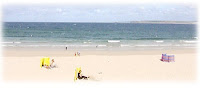 We decide to spend a sunny day at St.Ives. We lunch at the Porthminster Beach Cafe. Don't laugh - this is no Walls ice-cream candy-floss caff, but an excellent French-style bistro with real seaside atmosphere; outside eating under the awnings if you like, excellent food, and delightful waitresses. Replete with crab linguine and white wine, we stroll along overlooking the beach, and settle on a comfortable seat.
 The sand is platinum dust, the sea a sheet of lapis lazuli. In the distance we can see To The Lighthouse; round the corner, a real hurdygurdy softly plays pompitty seaside music. On the beach young fathers encourage their sons to paddle in the slurping waves, or to build impregnable sand-castles, and young wives recline and chat happily in their absence. It all has a wonderful sense of primal innocence, as in that never-never land of M. Hulot's holiday. Why do we feel that it is an epiphany from another world?
And then we realise. It is term-time; all the adolescents - well, nearly all - are safely in their cages. This is a world without (hateful phrase!) teenagers. What a sad thing it is that we should feel this. We have over the years known many youngsters at this time in their lives, and very enjoyable these encounters have been. But herd them into large groups, stuff their minds with yoof magazines and pop, encourage them to drink with no education in how to do it, lead them to think of drugs as a giggle, and they are capable of noisily destroying some of life's most precious experiences.
I ask myself whether I do not exaggerate a minor problem, as old men are inclined to do. Then comes news from the beautiful beaches of Newquay. The life-guards here have been given police powers to act to control drunkenness, drugs, violence, and social disorder among the young. This in some of the most peaceful and satisfying surroundings one could hope to come across in a life's experience. Enough to make you weep.
Friday, July 06, 2007

RAIN, RAIN, RAIN
One knows that there have been periods before when rainfall has been exceptionally high and continuous. So this is no different from any of them, is it?
All I can say is that there are times when it feels like it. The garden furniture lies damply on the patio. Shops are full of 30% reductions in the price of barbecues, chimenea, space heaters, swim-wear, hammocks.... Tell me that our weather has taken a sudden lurch into a wet climate and I will believe you.
Noah, of course, had faith that he would survive, but then he had only forty days of atmospheric depressions to bear. Did he know how long at the outset? And, anyway, how did all those animals survive once they were released from the ark - the ground must have been quite incapable of producing crops to feed them. As much of our farmland now is.
Feeling dismal at the start of another day of assorted rain and high winds is one thing: being told, as many have been, that there is no hope of their flooded homes being habitable for another two years is quite a different prospect. And the price of foods will rocket.
History books will record 2007 as one of the wettest this country has ever known. Who can guess what it will have to say about the aftermath?
The solution? To lose oneself in trivial occupations. Watching television is an alternative too banal to be contemplated - I think I'll try The Tmes crossword puzzle.
Tuesday, June 19, 2007

Square World .....................................................................................Frederick
ARTWORK
This is the latest to roll off the production line. Technique - Acrylic. Not much more to say about it: any confusion of themes probably reflects a lack of precision in the artist's mind. To see details click on image.
'Tis all a Chequer-board of Nights and Days
Where Destiny with Men for Pieces plays:
Hither and thither moves, and mates, and slays
And one by one back in the Closet lays.
Omar Khayyam..........Rubai 49
Sunday, June 17, 2007

EXMOOR MOTORING
Once upon a time there was a pleasant pastime called Motoring. This consisted of driving a car at moderate speed through pleasant countryside so as to enjoy the changing views. It became quite a cult, with add-ons. Your Motorist might enjoy nibbling Fry's Motoring Chocolate*, or could sport a pair of Dent's Motoring Gloves**.
With time, an increasing number of cars on the road made the whole operation less simple, but still possible. It was only with the arrival of the Aggressive Driver that opportunities for Motoring became increasingly rare. Whereas the Motorist would extend consideration to other drivers, as in pulling in to a lay-by to allow other cars to overtake safely, the Aggressive Driver delights in tail-gating any car that does not care to share his enthusiasm for breaking speed-limits, or in just skimming on-coming wing-mirrors (not always successfully). He ignores the passing countryside, which is one reason for its falling into decay. Motoring as an art seems destined to join the red squirrel as an example of a milder life-form being reduced to extinction level by an intrusive species.
But recently we spent a very pleasant holiday on Exmoor. We discovered that, in addition to the more widely known pleasures available, such as walking, riding, fishing, and killing wild animals, Exmoor is still ideal Motoring country. It does not seem to attract the Aggressive Driver, or indeed any traffic in heavy quantity. I suppose this is partly due to the scarcity of vividly exciting destinations. After all, once you have vroomed from Raleigh's Cross to Blackmoor Gate in record time there is not much more to do but turn round and vroom back again. Whatever the reason, we found it ideal for Motoring.
Won't your publicising it bring in hordes of extra cars, which will ruin it as Motoring country?
You exaggerate my influence. No-one ever takes my advice - which is why the world is in the state it is: don't blame me.
So, if the more rugged delights of Exmoor make you feel rather tired, consider a Motoring holiday, which is an option still open here. The roads do have their chicanes - going down Porlock hill surrounded by HGV's is a good opportunity to ponder on the frailty of human existence, while the subsequent negotiation of the village street will teach you the virtue of patience. But a bit of intelligent map-reading will enable you to avoid most of the problem places.
Where to stay? Winsford is an excellent centre, sequestered but easily accessible, and a pleasant strolling village. The discerning Motorist will make for Karslake House, where the warm welcome, attractive interior, comfortable beds, and above all the tradition of splendid cooking attested by years of rosettes, make the perfect background to a holiday of restful contemplation.


* Dark, with hazelnuts & raisins.
** String back; soft leather palm.
Tuesday, May 29, 2007

FEMINISM GONE MAD
No-one, I suppose, is going to suggest that the centuries-old struggle to rescue women from the position of social inferiority in which they were confined for so long is anything but one of the signs of slow maturity on the part of human beings which can fitfully be detected among all the fog and smoke of the 20th century.
The aim is impeccable, and the progress admirable. That is not to say, however, that some of the side-effects have not been deplorable. There are misgivings about the effect of these upheavals have had on family life, and many are sorry to see the status of home-maker down-graded from its central importance in a healthy society.
My immediate concern, however, is the effect on the English language. Language is a construct which encapsulates the heart of a civilisation, and ours is under a particularly raucous bombardment at the present. We can't afford to let enthusiasts for other considerations, however worthwhile, to feel entitled to monkey about with it irresponsibly.
Turning aside from idiocies such as 'herstory' as a substitute for 'history' there is the simple but essential matter of possessive pronouns. [Don't worry, dear, if your teachers hid this useful information from you - it's quite simple, really.]
'Every passenger must retain his ticket for inspection until he leaves the boat.' Couldn't be clearer, could it? Yes, we know that some passengers are going to be female, but the clear understanding in any sane mind is that what is being referred to is the human being and not only the male human being. Or, as the old grammar books put it, to the childish delight of the immature, 'The male embraces the female.'
But what do we now get? 'Every passenger [every single passenger, notice] must retain their ticket....or their tickets....' But how many passengers to a ticket? And how many tickets does a passenger hold?
Even writers as fastidious in the use of words as Alan Bennett can these days be read tying himself in knots in sentences on the lines of [I can't find the exact quotation]'Any man now writing, or woman for that matter, must ensure that they...' - when the whole point of the sentence is the singularity of the individual.
'His' means, and can only mean, 'belonging to him'. 'Her(s)' means 'belonging to her'. 'Their' means belonging to several people, not one. Let's get this straight.
Does it matter? Yes, it does. Despite all the marvellous advances of technology, words remain the the central means by which human beings keep in touch. When this tool becomes blunted in any way our power to understand each other is diminished, and never was there a time when that power was needed more than in the complex world in which we now live.
Monday, April 23, 2007

ARTHUR CONAN DOYLE
So Tessa Jowell has decided not to allocate any cash to the restoration of Undershaw, the home that Conan Doyle had built, and carefully adapted for the needs of his beloved Touie as she slowly died of cancer, on the grounds that he is not a Great Author 'like Jane Austen'. Well, no, he probably does not appear as required reading on the syllabus of any university Eng. Lit. course. (Not in Britain, anyway - I shouldn't like to take bets against his appearing somewhere in the American mid-west.)
But is that the only yardstick by which he is to be judged? As the creator of a fictional character as universally known as Hamlet (and perhaps more widely recognised); globally translated; appearing as play, film, and television in versions of wildly varying quality; and running through endless re-publications; Doyle is surely deserving of respect and memory. Not only do the Holmes stories represent the first real flowering of the detective novel; they present a detailed and endearing picture of Britain at the cusp of the Edwardian era. And not merely as a series of, to us, odd details which feeble minds may giggle at. He wears, according to the Paget illustration (though it's unmentioned in the text) a deerstalker hat, ankle-length coat, and spats, to approach Dartmoor. What a pantomime costume! But what could in fact be more fitting for an adventure which will see him lying out on the moor for nights - before the advent of Goretex and thermals?
Mostly, though, despite cartoon versions, he wears elegant morning dress with top-hat, except for short expeditions to the Home Counties, when he runs to a more doggish jacket and bowler. See the illustration above; where, incidentally, he is pointing out to Watson the tall blocks of the new Board Schools - 'lighthouses for the elimination of ignorance'. For all his bluff exterior Doyle was a man of wide sympathies: not his fault that the inner cities seem as insoluble a problem as ever.
As for his later pre-occupation with Spiritualism, it arose from personal grief, and if it were fantasy based on entire lack of real evidence it was not more so than the Catholicism in which he was brought up and so soon abandoned. And, of course, it brings us closer to what, for good or ill, was a preoccupation of the period.
If we live in a world in which it seems to be fantastic to analyse a man standing in the street as an ex-Marine sergeant by his appearance alone, that is only because our world is flattened and homogenised to a degree where real individuality (as distinct from the artificial twaddle devised by by the media) is so flattened by global (i.e. American) influences that it is more and more difficult to tell a Cornishman from a Cockney. And 'Passionate author remains celibate for years as his dear wife lies dying, though he is in love with another woman' would never make the headlines, would it?
And what does this Secretary for Culture offer as a sop to educated opinion? Why, to preserve 221B Baker Street - a fictitious address which, if it exists at all, does so as a tourist trap for the foolish, who may well be forgiven for being confused by the whole sorry business.
You're on about the Edwardians again, aren't you?
And what if I am?
It just makes you sound a bit of an old fuddyduddy.
I am an old fuddyduddy. Now get off my blog, whizz-kid.
Subscribe to:
Posts (Atom)