
Frederick
This is a watercolour of Pont's Mill, across the river from Fowey. It is based on a photograph of my own, taken in late autumn. I couldn't work in this detail devant le motif.

And what a feast of colour they offer us! I quote from but one edition -
'Slate, Anthracite, Shale, Navy, Dusk Black, Dark Spice, Ivy, Dark Charcoal, Dark Brown......'
Never mind, the girls will be wearing cheerful wintry colours!
These are the girls' colours. Men are offered an even wider range of glumness -
' Blackberry, Hickory, Mahogany, Midnight Purple, Dark Earth, Iron, Hematite, Deep Lake, Dark Indigo, Dark Forest.....'
'Gone into mourning, one might imagine, for the death of the sun.' Why do we allow ourselves to be cowed into accepting whatever the rag trade decide is 'in this season'?
I tried to buy a short mack for the winter. My favourite outfitter could produce just the thing - in a shade I can only describe as frozen spinach past its best. 'Another colour?' 'I'm afraid they're all like this at the moment, sir.' So look forward to grey streets filled with trudging figures wearing boggy garments this winter, just when we could do with a bit of cheering up.
Of course, when it gets really cold........


English has spread widely as an international language, partly because of American global dominance, but mainly, I think, because it has rid itself of a lot of fiddling details that still bedevil other languages. It is not cluttered by diacritical marks, umlauts, accents, cedillas, and the like. It is rarely bothered by gender, whereas in European travel your French feminine shirt is suddenly neutered as you pass into Germany. It is possible to speak faultless English while remaining blissfully ignorant of the subjunctive (though old people sometimes like to play with it as an intellectual exercise).
On the other hand it has a number of ineradicable disadvantages. One is its irregularity of spelling and pronunciation - the 'cough, bough, rough' syndrome is frequently held up to scorn by rivals. Another is its unwillingness to abide by any set of rules - the moment you have sorted out a clear mnemonic the exceptions come crowding in. All the more reason, then, to cling to whatever basic principles can be established.
Take the simple word 'cover' for example. (Pronounced 'kuvv-er', for those of you in the back row.) Characteristically for an English word it has an array of uses. When we put the lid on something we 'cover' it. What we put on it is a 'cover'. The item is then 'covered'. When we take the lid off we 'discover' what is underneath. We tell the world of our 'discovery'. On the other hand if we 'uncover' something we hint that we have found something a bit shady - under-cover. With luck we may 'recover' the stolen goods that have been hidden by the thief. (But notice the subtlety of the language - 're-cover', with the hyphen written or implied by intonation, is something you do only to books, armchairs, and the like.) All this is connected to the basic word 'cover'; and once a newcomer to the language has managed to grasp that we are in the same league as 'lover' (but not 'hover' or 'Dover') then all is plain sailing.
Why on earth then do some people suddenly introduce a different pronunciation? An alternative (older) version of the adjective is 'covert' - still meaning 'with a lid on', and pronounced 'kuvvert'; still intimately connected by pronunciation and meaning to our basic 'cover'. Secret operations are carried out under cover; they are therefore 'covert'. They are carried out 'covertly'. If you happen to be a small wild animal being pursued by red-jacketed men with dogs you may seek cover in a covert, a patch of dense foliage. The owner of the land, in the days when men still wore overcoats, might sport a covert coat, a short overcoat suitable for tramping through the undergrowth covering the covert. If he bred horses he would have his own technical use for the word.
All this richness of language is organised under the word 'cover', and we do language a disservice if we deck it out with fancy pronunciations which seem to indicate that 'covert' is just any odd word that happened to be lying about so we grabbed it. And we make the language just that bit more difficult for the newcomer.
None of this has anything to do with 'cove' [COEv] - a curved inlet in a coastline (or a rather disreputable figure in an Edwardian novel).
But just as you think that it's all very easy really, notice the Cornish village of Coverack - pronounced not 'kuvver-ak' but 'cov-rak'. Ah, well.
Arlington Court is a National Trust property on the western edge of Exmoor. The house itself is lumpy externally, but rather splendidly domestic inside. The grounds range from a Victorian formal garden to tracks through the wilder bits of the estate, including a lake.
There is a very fine collection of horse-drawn carriages of all kinds, housed in a special block of the stables, and visitors can take horse-drawn rides at a sober clop round the grounds. However, I caught the equipage just after the last amble of the day, when the horses were travelling light on their way back to the stables.


I complained on 22 March of the antics of foolish stage directors, perhaps with a half sense that this was yet another sign of the daftness of the contemporary world.
I am relieved in some ways to have come across a reference to Alec Guiness's production of Hamlet in the 1960s, in which Ken Tynan, playing the Player King, was required to wear a large false plastic ear for Lucianus to pour the poison into, for all the world, as Tynan put it, as if it were 'an advertisement for a proprietary brand of rum'. So arrant stupidity is not, after all, a characteristic of directors of the twenty-first century only.
There seemed to be more point, in a production in which I was involved, in putting the Players to act in half-masks, to detach them from the real world. The only snag from my point of view, in this and other productions, has been that actors always want to keep their masks as souvenirs, so that I have no reminders of all the work that went into designing and making them. In this case I put Lucianus into black and silver, corvine, with a laid-back plume, and Prologue into scarlet and gold, cocky, with a tuft on top, rather, in retrospect, like a cross between a cock and a hooded kestrel (a coistrel ?- see Twelfth Night)
The two lads playing the parts could not agree who should wear which, so they ended by changing parts each night. I can't remember who took home which, but certainly I never saw them again. So eventually I had to make a set of display masks for an imaginary ballet of the Four Elements to put up at home. The picture, in case you have been wondering what it had to do with directors, is such a mask, for Water, shown only in the hot dry months of summer. Perhaps it has been performing a rain dance.

 CONFUSION WORSE CONFOUNDED
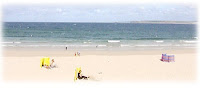 We decide to spend a sunny day at St.Ives. We lunch at the Porthminster Beach Cafe. Don't laugh - this is no Walls ice-cream candy-floss caff, but an excellent French-style bistro with real seaside atmosphere; outside eating under the awnings if you like, excellent food, and delightful waitresses. Replete with crab linguine and white wine, we stroll along overlooking the beach, and settle on a comfortable seat.
 The sand is platinum dust, the sea a sheet of lapis lazuli. In the distance we can see To The Lighthouse; round the corner, a real hurdygurdy softly plays pompitty seaside music. On the beach young fathers encourage their sons to paddle in the slurping waves, or to build impregnable sand-castles, and young wives recline and chat happily in their absence. It all has a wonderful sense of primal innocence, as in that never-never land of M. Hulot's holiday. Why do we feel that it is an epiphany from another world?
And then we realise. It is term-time; all the adolescents - well, nearly all - are safely in their cages. This is a world without (hateful phrase!) teenagers. What a sad thing it is that we should feel this. We have over the years known many youngsters at this time in their lives, and very enjoyable these encounters have been. But herd them into large groups, stuff their minds with yoof magazines and pop, encourage them to drink with no education in how to do it, lead them to think of drugs as a giggle, and they are capable of noisily destroying some of life's most precious experiences.
I ask myself whether I do not exaggerate a minor problem, as old men are inclined to do. Then comes news from the beautiful beaches of Newquay. The life-guards here have been given police powers to act to control drunkenness, drugs, violence, and social disorder among the young. This in some of the most peaceful and satisfying surroundings one could hope to come across in a life's experience. Enough to make you weep.


The National Trust has issued an appeal for funds to protect the Lake District from erosion, climate change, and other problems.
Cleverly, it illustrates its brochure with an account of Wastwater's problems, together with a section of walkers' map. I don't like to live in the past, but inveterate mapsters like me, given a bit of map, inevitably begin to trace past expeditions. Here is Nether Wasdale, where I spent the night those - good heavens - sixty years ago, and here is the route up the side of Wastwater, where I stopped and removed my boots and socks and dangled my feet in the lake.
Now, I was suffering at the time from a neurosis which had the effect that whenever I found myself in a pleasant situation my mind was crossed by a sense of unease, like a cloud passing over the sun. I had much to be glad of; I was young, I had survived the war, I had a place at Oxford; and yet the nagging sense of insecurity often intruded. Perhaps I unconsciously feared that the Djinn would arbitrarily reverse the magic and that I should suddenly find myself back in a bleak transit camp. Anyway, as I sat with my feet in the water a shoal of little fish gathered round them and began to nibble very gently. I had been enjoying this odd experience for some time before it occurred to me that I was in a strangely happy situation - and no shadow had passed over my mind to disturb it. And it never did again.
With a wonderful sense of escape I carried on up the dale to the Wasdale Head Hotel, where I proposed to have something to eat; but they were not serving food that day (it was the 1940s, remember). This was such a set-back that the stout lady behind the bar said that perhaps they could 'put me up a bit of a cold plate'. When it arrived it was the largest mixed platter I had ever seen. Some time later I set off again, over Black Sail Pass to the Youth Hostel, reputed at the time to be the most remote outpost of the YHA (perhaps it still is).
In the small hours a wild enthusiast roused us out of bed to stand in the shivering cold to see a great silver moon rising over Scafell - all except an Indian student who refused to get up, on the logical grounds that he had seen the moon before.
All this, half-forgotten, re-created by a meander along a line on a map. I must make a contribution to the appeal - perhaps there is some other chap out there who needs to dangle his feet in the water.
 DESTRUCTIVE DIRECTORS
