Friday, October 22, 2010


MORE ILLUMINATION
Here it is, then - what I have been doing while I have not been blogging for some time. Some improvement, technically. I think the calligraphy requires a good deal of practice, though.
Click to enlarge, if you want to criticise.

Tuesday, September 28, 2010


So the rotweiler of the vatican has been magically transformed into a dear little benign pope, sitting on his portable throne like a child on a bouncy castle, waving at the assembled gullible (with a noticeably high proportion of shipped-in children).

As to that nasty business of the pederastic priests, he has made ample atonement, has he not, by apologising for their regrettable behaviour? Well, only after the truth of the whole sorry story had at last been uncovered.

What he has signally failed to do, and clearly has no intention of doing, is to apologise for his own part in the frantic efforts to obfuscate the whole issue by shuffling proven pederasts to alternative posts, where although abominably guilty they could continue to function as priests; and by doing his utmost to prevent the facts becoming known.

It has been suggested that he should be prosecuted for obstructing the due process of the law. While it is obvious that in any society with a sense of moral standards he is manifestly guilty, the power of the papacy, though diminished from the good old days of the Inquisition, is probably still enough to ensure that any such charge could be conveniently lost in interminable legal flummery. Hardly worth the effort, merely to demonstrate the invisible worm in any religious bud.

Sunday, June 20, 2010


UNCORKED
A particular nastiness has crept into the sybaritic world of wining and dining. I refer, of course, to the screw-top wine bottle. This seemed at first sight a trivial matter, but subsequent experience has shown that there's more to it than this. With the increasing use of this penny-pinching device are disappearing a whole range of minor traditional pleasures. We are assured that this glib new trend will ensure that our wine will never be corked.
So there is no need now for the happy ritual, is there? The display of the label. The careful cutting of the capsule with the wine waiter's knife. The swift realigning of the tool to expose the corkscrew. The skilled turn of the wrist as the screw is driven home. The flick which exposes the fulcrum on which the cork is withdrawn. And then - oh, happy moment! - the plop of the release. The assumption that one will want to check the state of the wine; a little poured into the bottom of the glass. A quick check of the nose, a swirl around one's tongue, and the word of acceptance. Only then can the pouring begin.
And to replace this? The bottle plonked down, a muscular twist of the wrist, and there you are, mate. What next? Crown corks, I shouldn't wonder. All this, of course, is seized upon by the colonials, for whom hygiene is all and mystery nothing. All these bottles of wine ruined because it is corked! After a long life-time of happy bibbing I can recall only two occasions on which the wine had in fact deteriorated: surely a small loss for the vintner to cover.
How to avoid this grossness? Stick to the great wines of France, Germany, and Italy - which is far the best advice, anyway - and search the upper shelves. Presumably the good wines will always be traditionally presented, but I have an uneasy feeling that that the ordinary drinker will find his choice gradually more and more restricted.
And how about spin-off, in this global age? The little cork-oak plantations of Portugal where a whole way of life is threatened by the drying-up of demand for the crop of these strange trees? Well - tough.

Friday, June 04, 2010


ASTONISHING COALITION!
So - we are all settling down to this dangerous new idea in British politics. What tense negotations brought it about! How loud were the forecasts of disaster! And what an unheard of thing it is!
Why? Even our present mediaeval system of elections brought about a pretty accurate reflection of the will of the electorate. A large proportion of the population is interested only in football. So only a little over half of the electors voted at all. No-one believes that any one party has solutions to all our problems. So voting was pretty evenly divided between Conservative and Labour, with a bit of a tilt to the Tories. A sizeable proportion of the population thought that neither of the main parties knew what was best. So there was a block of votes for the Lib Dems and other minorities.
The country as a whole operates only as a compromise between a great variety of interests. So what more natural than that we should have a government that goes some way at least to representing this kind of mixture? It would be ridiculous to have a government that presented a picture of Britain as a monolithic Tory stronghold, or as exclusively Labour. As it is, some of the dafter policies of the extreme wings of the parties have had to be dropped or modified, and a good thing too.
'But a coalition government won't work!' Then how about all the countries where it works very well, and people have long ago stopped getting all pink and excited about it?
Even the out-dated electoral system we have inherited has presented us with a more rational mix of political opinions in power. The presence of the Lib Dems will ensure that a new electoral system will approach even nearer to ideals of a just representation of a highly diverse population. All that then remains is to get rid of the yah-boo arrangement of seating imposed on the re-built House by Churchill after the war, and there is a real hope that debates may begin to sound like serious discussions of real problems, and less like witty point-scoring in the Oxford Union.
May coalition government have come to stay, is what Tiresias says.

Friday, April 16, 2010

EUROPEAN CONFORMITY

Europhobes are constantly trying to frighten us with the idea that closer contact with Europe will enmesh us in an ever-closing net of dull uniformity. How far that is from the truth can be easily established by a glance at any range of medications.

I, for example, like many of my age take six forms of medication daily, some many more. Some old people find it difficult to keep track of their dosage. You would think then that a simple standardisation of packaging, with clear instructions, would be of great advantage to all concerned, and easy to achieve. Not a bit of it.

Of my tablets and capsules, three come in packs of fourteen; but two come in packs of ten, and one in packs of seven. Consequently, over time, I begin to run out of some types of medication before others. One type, ordered on the prescription form in batches of eighty-four, is marketed only in packs of twenty, so I am constantly being cluttered with cut-off bits of pack containg twos or fours to make up the number. Of the packs of ten, one is arranged as two rows of four and a split row of two, the other consists of two rows of five each. Of the packs of fourteen, one displays two rows of seven with a calendar marking, another shows two rows of seven without a calendar, and one runs vertically, four down the left side, four up the right side, and two down the middle, like a country dance. Oh, and it displays a calendar, but in Spanish. All right as long as you remember Placido Domingo.

Perhaps the finest example of the pill-packers art is the pack of seven; not, as you might expect, a small pack, but in a form larger than any of the others, displaying ten huge pods, three of which are empty, and none of which contains anything larger than a standard capsule.

Add to this that most of these medications have at least two names - one, indeed, oscillates between three - and you have the perfect formula for confusion. It's a wonder that little old ladies aren't dropping like flies all over Europe. I exclude the possibility of securing co-operation from the Americans, who still measure screws in inches and always write the date backwards, but I do feel that sensible Europeans could collaborate in a more rational system of presenting medication.

Sunday, March 14, 2010


TRADITIONAL BRITISH SPORTS
Ideas, as well as the language that expresses them, can become down-graded by usage. Take the idea of grooming - taking great care of a well-loved horse, or, if you are wealthy enough, employing a servant to do it for you, as in Stubbs's painting celebrating such a gentlemanly interest. And now it has become a furtive activity performed by the sexually frustrated under cover of the internet, to seduce young girls who think they understand the modern world, but are foolish enough to believe what they see on the screen. Often the consequences are saddening, or even tragic.
Or stalking. Why anyone should want to crawl about on a damp bleak moorland in order to observe, or photograph, much less kill, a stag is a puzzle in itself. But it was, even perhaps including the matter of slaughter, an undoubtedly gentlemanly occupation; engaged in by the heir to the throne, no less. Now it has come to mean hanging about on street corners with intent, or worse; with the intention of establishing a relationship which is doomed from the start.
These are aspects of a grey and sleazy world which hides behind techno-glitter to deceive itself into believing that it is engaged in the pursuit of happiness.
And yet - Morecambe & Wise sang of stalking avant la lettre - "You walk fast, I'll walk faster; I'll stick close, like piece of plaster; Get my kicks, following you around", and no-one thought them any the worse for it. But then, those were the days when two men could share a bed, and all you waited for was the ice-cream van gag, or talk of Ada Bailey. How naive we were.

Sunday, January 31, 2010


GOYA'S HAT
What a remarkable man Goya was! His ability to show the obscene horrors of war, or the grotesque limits of the human face, or to depict the Spanish royal family as if they were a problem family who had just robbed a theatrical costumier's store - and get away with it - places him in the forefront of fascinating characters.
But for me one of the oddest aspects of this man lies in his own self-portrait. He wears a torero's jacket from a suit of lights, because that was the macho thing to do at the time, though he never appeared in the bull-ring. But the hat? No self-respecting bull-fighter would appear in such an odd thing. We are assured that it was a hat he wore for painting details in a poor light, and that it was fitted with candles to light up his work. But look at these candles - about 1 cm away from the crown of the hat. Surely if they had ever been lit the whole hat, and possibly Goya himself, would have gone up in smoke.
Or is this hat really just a project, like Leonardo's flying machines and battering rams, that never got past the design stage? He glowers at us under the brim, as if defying us to disbelieve him. But I for one am not convinced. None of the candles are lit, because there is plenty of light in his studio, which he has painted in for us. So why is he wearing the hat at all? Trendy showing-off, which always appears daft to succeeding generations.

Friday, November 27, 2009


FOREST GREEN
'The forests are ringing beneath the axe; thousands of millions of trees are perishing; the habitats of animals and birds are being laid waste; rivers are dwindling and drying up; marvellous landscapes are vanishing beyond recall..... and with every passing day the earth becomes uglier and poorer....

'Forests moderate the harshness of the climate. And in countries with a gentle climate human beings spend less of their strength on the struggle with nature; they become gentler in their turn.
'In places like that people are lithe and beautiful, with quick responses, and well-turned speech, and graceful movements. Their arts and sciences flourish, their philosophy is never sombre, they treat women with grace and honour.....'
There you have it, the latest inspiring ecological thinking, combining an abrasive shot of reality with a vision of the profound effects that rational action might bring to the lives of us all. And who is speaking? Anton Chekhov, through the mouths of characters in Uncle Vanya, writing in the nineteenth century.
And what has happened in the course of over one hundred years? Nothing but more of the same, accelerated by slicker technology.
At long last there seems to be an awareness that a few tentative steps towards arresting the slide to disaster might just save something from the ruins. But it's only because those able to take action are by now thoroughly frightened by the alternative scenario that this is occurring. And will the Chinese abate their stampede towards more and more coal-fired power stations? Will the Americans ever pause to consider the consequences of their neurotic air-conditioning and their ridiculous over-heating of buildings? And will.......?

Thursday, October 29, 2009


SLOW JUSTICE


Why does legislation which clearly rights injustice, or introduces obvious improvements, or treats the individual with understanding, or in any other way must clearly be of advantage, take such an interminable time to reach the statute books?

The farcically classic case is the decimalisation of British coinage. The first move towards this obvious reform came in 1849, with the introduction of the florin, value one tenth of a pound. Thereafter bill, proposal, and agitation came and went: but nothing happened for one hundred and twenty years, until a gigantic struggle managed to bludgeon through a stupid House the Decimal Currency Act of 1969.

So with the Married Women's Property Act. Previous to this a married woman lost all rights to her property, which passed automatically to her husband, and many husbands are on record of exploiting this whip hand without mercy. The scandalous Norton case brought it to public attention, but it was a further fifty years before this gross injustice was set right.

A widower was forbidden to marry the sister of his dead wife, even though she was frequently the obvious person to care for him, so they had to choose between giving up this opportunity or Living in Sin. It took another fifty years of agitation before anything was done to remove this nasty little prohibition - and why? You've guessed it - it was written into the Book of Common Prayer; religious, and therefore infallible.

The Wolfenden Report proposed sensible reforms to the laws on homosexuality, which had long been a gross invasion of human rights. Oscar Wilde's was only the most prominent among many thousands of lives destroyed in one way or another by this bigotry. Yet once it had been published it took ten years of arduous campaigning to get this level-headed approach on to the statute books.

And today? Many lives end in torture, degradation, and misery, because those suffering are not allowed to choose to end them peacefully. Sooner or later this stubborn denial of the individual's right to control his own life will no longer be enforceable, and men will wonder that we have put up with it so long. But meanwhile the prolonged struggle goes on, wresting a little relief here, a slight softening of revenge there. In the House of Lords noble gentlemen quote statistics showing the degrading effect of reform on societies where it exists - all totally inaccurate and refutable, and bishops maunder on about the sacredness of human life. Quietly the sensible and humane mine away in the dark tunnel. Eventually they will blow the whole conspiracy of silence to the sky.

But I shall not live to see it. I can only hope, like all of us, that my end will not be too painful or degrading.

Thursday, September 17, 2009


IN ENGLISH - WITH SUB-TITLES IN ENGLISH?
The last night of the Proms. A time when there are likely to be a number of young minds making their first acquaintance with splendid music. So, the organisers give us an excerpt from 'Dido and Aeneas', beautifully sung by Sarah Connolly. The voice reaches a passionate phrase. But what is she singing about? If the young listen carefully they will hear her enunciate - 'ghu-MAH-ma-mah, ghu-MAH-ma-mah!' Old hands lucky enough to know where we are in the music will know that this is where Dido cries so piercingly 'Remember me! Remember me!' But the vowels and consonants are not easy to sing - so Connolly does not sing them. Baffling to the newcomer.
She is not alone in this. Joan Sutherland used to sing whole operatic roles in a handy language all her own. This seems to me to show a contempt for language; it implies that musical considerations can trample words underfoot.
Tate's libretto is feeble stuff, and at times risible, but it is the framework on which the whole work hangs. If we are not told why Dido cries out so piteously what is the point?

Thursday, September 03, 2009


WHY DO I NOT LIKE THE PRE-RAPHAELITES?


The Pre-Raphaelites sought to distance themselves from the general run of nineteenth-century English art. This immediately recommends them to my imagination - a fresh start, a new angle. They will not imitate the imitators of Raphael, with their conventional triangular rules for composition, or the smooth studio light that falls evenly over all subjects. They will look at the real world, and subject it to an intense vision which will distill its essence. They will study and practice the rendering of colours and surfaces with a skill that verges on trompe l'oeil.


Living as I do in a world of art which seems to place great importance on the scratchy cartoon style I ought to find myself very receptive of PRB paintings. Yet this is not so. My immediate reaction to most of their works is one of indifference, and frequently of repulsion. I ask myself why this is so.


Like most questions in the field of the arts this does not permit of a glib answer. Take Holman Hunt's Hireling Shepherd. This ought to be a painting I find approachable. It appears to consider the nineteenth-century marshmallow approach to the rustic world, and give it a good sharp twist. This swain and maiden are possessed of earthy characteristics; their skin is rough and sweaty; whatever they are up to it is not the study of lepidoptera; they sprawl on gritty ground (albeit with an unusually fine display of native British flora). The sheep untended go wandering in a way which will take a deal of sorting out later. And behind all this, and in happy contrast to it, the calm of the countryside as seen at a safe distance charms the sentimental eye. The technical skill in the rendering of shape and texture is exquisite.
And yet I find it repellent. The fact that it is obviously intended mistily to suggest ideas of sacrificial lambs and good shepherds doesn't help - I dislike being got at. (And anyway - 'the good shepherd careth for his sheep.' But why? So that they will make a good price when they come to be slaughtered - that's why. But I wander.)
But basically I think my revulsion is due to the fundamental dishonesty of the resolution of vision. Hunt has certainly observed with precision and understanding every blade of grass, every strand of a sheep's wool, and he has rendered them with microsopic clarity. But we do not see the world like this. At any moment our mind is concentrated on a minute area of our field of vision. At the same time we are aware of surrounding concentric circles of visual images of decreasing precision, and we we constantly rapidly and unconsciously shift our concentration to other points in this vaguer penumbra. But Hunt shouts at us that we must be aware of the leaf on the shrub, the wrinkle in the stocking, the crease in the apron, the back-lighting on the lambswool, and....and....and...., all at the same time and with the same intensity. It is a hard sell, and the mind backs away. Or mine does, anyway.

Monday, August 31, 2009


SCOTLAND THE BRAVE
The al-Megrahi affair has shown up a number of individuals and institutions in characteristic attitudes.
The release of al-Magrahi on compassionate grounds presents a picture of a Scottish government acting boldly on its own convictions. (It is only a pity that some Scots political parties have seen fit to muddy the waters for what they see as political advantage.)
The attempted bullying by the FBI is a gross interference in another nation's affairs - a not uncommon attitude in that quarter. Are American neo-cons really so naive that they think that terrorists around the world are thinking, 'I'll get involved in a terrorist act; then if I can contract a terminal disease I shall have got away with it'?
The anguish felt by American parents who lost their children at Lockerbie is totally understandable. One is saddened, however, that it should so often take the form of the kind of rant extruded by the gun lobby: they seemed disappointed that they had been denied the pleasure of watching the accused dying behind bars.
The contrast with our own Dr. Jim Swire is marked. He too has suffered the death of a dearly loved child, yet he continues to maintain that the original conviction of al-Magrahi was unsound, and to campaign on his behalf.
Nothing can condone random acts of terrorism. Yet one can only notice a kind of horrible distorted justice in the arguments of Islamics who point to the shooting down of the Iran Airbus flight 655 in July 1998. The USS Vincennes was in breach of Iranian territorial waters, and failed to recognise a civilian aircraft on a scheduled flight. 290 pilgrims were killed. After attempts to deny the incident had been shown for the lies they were, the captain who gave the order to fire was awarded the Legion of Merit. The comment by Old Bush sums it up - 'I shan't apologise. I don't care what the facts are.' Fundamentalist religious beliefs are no excuse for wanton violence, on either side.
The stage-managed reception of al-Megrahi on his return to Libya was, to say the least, very unfortunate and ill-timed. But then Gadaffi has no taste.
An American actor, recently asked for his opinion on the al-Megrahi case, on a BBC chat show, replied, 'I sure want to see that guy dead!' The anchor-man, John Sargent, was visibly taken aback, as well he might have been. (Any intelligence that the interviewee might have possessed was easily masked by the fact that he was wearing the loon's head-dress - a baseball cap indoors.)
The American right presumably wastes little time watching performances of plays by a back-number Brit such as Shakespeare. Otherwise they might have pondered the fact that earthly power doth then show likest God's when mercy seasons justice.

Wednesday, August 26, 2009


COMPLIMENT / COMPLEMENT

The latest glossy illiteracy to drop through the letter-box -

'NEW! Now you can have a beautiful dinner-table, with napkins specially colour-coded to compliment your table-ware!'

One imagines the delightful conversation:

'May I compliment you on your latest colour scheme, Lady Denby-Ware?'
'Certainly not, Mr. Napkin. Get back under the table where you belong!'

Sunday, August 23, 2009


GRUMPY OLD MEN


Why are you such a grumpy old man - always complaining about something?

I'm not grumpy by nature - in fact I am generally thought to be a rather jolly old codger, as you can see. And as I approach the end of things, for 'death, a necessary end, comes when it will come', I should like to think that my generation were leaving something worth while to the next.

But circumstances make it increasingly difficult. There can be no doubt that, looking back to my youth, I see a great many things that have deteriorated. Life in the streets is more violent - we only go out at night for a visit to the theatre, or a restaurant. Apart from that we are more than content to stay at home. There are compensations, of course. We have at our finger-tips a whole range of DVDs of great films and television. Music pours into the room with a startling clarity unknown a few years ago. But the world of strolling and chatting has faded.

In those days I was able to tour the country by cycle, on roads that were fairly quiet at the worst, and frequently, with a little map-reading, deserted. Cotton shirt and shorts, and panniers to carry a little kit; 3-speed Sturmey-Archer gears if one was lucky; and one was away. Nowadays they all seem to think that they are competing in the Olympics - hard hats with streamlining of no value whatever, tight lycra, t-shirts of distressingly discordant patterns, and above all, expressions of grim determination. When was the last time you saw a happy cyclist?

I won't multiply examples, but you will know what they are.

And taking a wider view doesn't help at all. There is no doubt at all now that we have ill-used the planet,and that it is in a shabby and run-down state. Those who come after us may be able to patch it up a bit, but most of what has gone is gone for good. Tribe quarrels with tribe, and generally seems to have no answer but blind rage and killing - especially when fuelled by the myths of the religions. The greatest power in the world seems to have no concept of constructive action, but launches its young men into campaign after campaign which in the nature of things it cannot hope to bring to any valid conclusion. Harry Patch said, 'In the end it comes down to talking, so why can't they do the talking first?' But nobody listens to us old fogeys.

Yes, I'm glad that I can make an appointment to see my GP whenever I want, instead of queuing up in a bleak waiting-room for the next turn. Yes, I am glad that the various conditions that are attendant on old age are comfortably controlled by better and better medication. Yes, I am reassured by the fact that when the weather turns bleak I can order our groceries on-line, and they will be delivered to our door - and in a great profusion unimaginable to me as a boy. And so on and so on.

But always there is this nagging sense that one world at least is coming to an end - youngsters kill each other on the streets for no reason, public facilities are mindlessly vandalised, popular music is a mass of violent noise, everyday speech as heard on radio and television is a mumbled jumble, and....and..... And what's new?

We have been converted to digital TV. Hooray! Our picture is now much brighter and sharper. But what is the greatest new feature that I am invited to wonder at? We are now able to receive no fewer than 70 channels! Of these about half a dozen sometimes show something worth watching. The remainder pour out a vast sewage of noise and clatter, of no imaginable value, ready to be lapped up by the rising generation.

Is it any wonder that I may occasionally give an impression of being grumpy? But saddened is what I really am. This is not the world I voted for in 1945.

Thursday, July 16, 2009

I PROTEST!


What are these good people doing? Yes, that's right, sonny, they are protesting. Every Englishman's born right. But let's be quite clear - they are proTESTing. They are proTESTors. What they are engaged in is a PROtest, but that doesn't make them PROtesters. I proTEST that this is another nasty little distortion of the English language - imported, like as not, from Silicon Valley.

Along with that other increasingly popular mangling of decent speech - SUBscribers, who presumably SUBscribe to magazines or whatever. SubSCRIBERS, please. I suppose they don't pay a SUBscription - or, awful thought, do they? Anything goes.

The destruction of the English language seems to have developed a hideous momentum of its own, like a Greek tragedy. Take 'refrigerator'. A large mouthful for a common thing, so we contract it. Chambers lays it out quite clearly - contraction 'frig', pronounced, of course, 'frij'. But no, it must be spelt 'fridge'. I have waited years for the inevitable to happen, and the other day it did. A glossy brochure proclaimed the qualities of the latest - wait for it - 'refridgerator'. Another victory for the hordes of text-messagers.

You don't care? Many don't. I do.
Monday, May 04, 2009

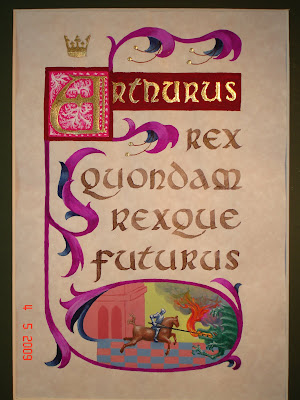
ILLUMINATION AT LAST

So this is it, then - my excuse for the infrequency of posts lately; all my creative energies have been devoted to conquering this difficult task of illumination. The colouring is in gouache, which is a quite different technique from transparent watercolour. The gilding is something again, but I have made a post about this before.

I am quite pleased with this as a first effort, though the process of photography serves to disguise the fact that the gilding starts off pretty rough, but I was able to polish my technique as I went along.

Watch this space for more examples of this very retro art in due course.

Wednesday, April 29, 2009


RELIGIOUS THINKING


I have never touched on the subject of religion in this blog, mainly because the claims of the sects seem so meaningless and contradictory; but the sight of a Professor of Theology vapouring on TV recently on the subject of Darwinism has so enraged me that I feel I have to register a protest.


First to clear the ground. There are among many shades of thought two main types of thinking.


In logical thinking the process is to examine the phenomena, and to propound a hypothesis. The thinker then collects all the available data connected with the subject, and considers whether all or most of it supports the hypothesis. If this is so, then the hypothesis is accepted, at least for the time being, before it is supplanted by further information. A clear example of this kind of thinking is scientific study, though it is by no means confined to science. Its progress may be traced in the increased understanding of the shape of the universe provided by Copernicus, followed by Newton, followed by Einstein.


The other main type of thinking is religious. Here the process is to devise a theory. This may be the result of long hard thought, or it may just float into the mind - a process dignified as 'revelation'. Once the theory is felt to be acceptable, for whatever reason, a search is then made for all the data which may support it. Any contrary evidence is disregarded, or may be labelled as heresy, or may even be actively suppressed. The essential feature is that the conclusion must coincide with the original idea, and thinking proceeds backwards from this point. Ironically, a poet as deeply religious as T.S.Eliot summed it up perfectly - 'The end is where we start from.' The idea can then be reinforced by embalming it in dogma or holy writ. Men such as Galileo have been threatened, or tortured, or killed, for denying such embalmed chunks of prejudice. Darwin himself was inhibited for years from publishing the truth by the thought of the religious vilification he would have to undergo.


All this was brought to my mind by the antics of the theologian in seeking to explain that a belief in evolution was not incompatible with religion, since that although the irrefutable facts of evolution clearly show that much of biblical teaching is no more than fantasy, yet God had employed evolution as a tool in his creation of the world. This is to reduce the Bible to the level of a tale with coloured decorations.


How an apparently intelligent man could go about thus sticking plasters on a rapidly deflating balloon, when the increasingly obvious fact is that religiosity is merely a contrived, if fascinating, myth, and that the fundamental nature of the world about us, though terrifying in its complexity, is only to be understood by the gradual accumulation of carefully observed and collated fact, and not through a a cloud of vague and contradictory imagining, I find it difficult to understand.


But then, of course, he knew the answer was 'God' before he even began to consider the problem.


Saturday, April 04, 2009


WHO GETS THE BONUS - AND WHY?

When I began this blog I promised myself - and anyone who happened to be looking over my shoulder - that I would never say 'I Told You So'.

So it is with a great deal of self-control that I just manage to adhere to this rule at present. All I will say is that if you care to look at my post of October 10 2007 you will see an accurate forecast of the financial disaster to come.

It cannot be that I have a clearer understanding of global wealth creation than the masterminds of the industry; after all they must be possessed of a good deal of low cunning to have got where they are (or were until recently). The only answer must be that they are much greedier than I am. They've certainly done a deal better out of recent events than I have.

And the solution? I suggested for a start that credit cards should carry much more advice and supervision. The other day I received a new card, carrying a little sticker reading 'Use credit wisely'. Well, it's a start, I suppose.

Perhaps if I gave some more advice it would also be followed. And then perhaps not.

Friday, January 02, 2009


IS MY JACKET STRAIGHT?


Ignorant use of language is always irritating, especially when it leads to confusion of thought or communication, but the most annoying form is where the speaker or writer is trying to create an impression by using words and phrases which may sound splendid but which he has not bothered to master.

A common example of this is a jeering reference to some older female relative as 'straight-laced'. Quite where this lace is being worn, or how it is kept straight, has never been thought out. English has two similar but distinct words in this area.

'Straight' means not wandering from side to side; as in a straight line, which those skilled in geometry know as the shortest distance between two points. So you can twang a stretched chalked cord to mark out a straight line.

'Strait' comes from a different source and means narrow or restricted. If your elderly aunt wears a corset her maid can pull at the laced-up back until Aunt is restricted into a suitably narrow shape. Aunt may not be able to move with any ease, though, and the scope of her activities is limited. So, the phrase suggests, is her mind: strait-laced.

The Straits of Dover are a narrow seaway. A strait-jacket is a garment for restricting the movements of violent patients. People who are severely limited in cash may be thought of as being in dire straits. [I was heartened to see that the group who took this as a name at least knew how to spell it.]

This not the only use of fuddled imagery. Patients born with a split upper lip need surgery to correct the hare-lip, which is no impediment to a hare. What the user thought of as a hair-lip I can't imagine - a kind of intrusive moustache?

Playwrights construct plays, as a metal-worker constructs wrought iron. So the original Mr. Arkwright built arks, or ships; Mr.Wainright wains, or carts; a wheelwright wheels.
None of them needed to be able to write. So let us have no more playwrites.

You think I refer to non-existent blunders? Within the last month I have seen in B&Q's bathroom area printed containers of 'Sealing Tape for Sanitary Wear'. Investment companies have advised me to reign in my spending. A man has boasted of travelling about in a decade old Buick - the wrong pronunciation of the wrong word. They're out there all right, the vandals who trample on the English language.

Tuesday, November 18, 2008


ILLUMINATIO MEA

Wozziss all about then, eh?
It's about the ancient craft of producing manuscripts by hand, and especially the art of decorating them with patterns, miniatures in capital letters, natural and fantastic forms, but above all by 'illuminating' them by the addition of real gold leaf.
This is a very tricky process, and mastering it has taken up a good deal of my time lately - hence the lack of posts recently. I have however manged to devise a pretty fool-proof technique, and in my usual generous way thought it might be a good idea to publish my findings. so -
GILDING
Gild before painting, except for minute areas.
Outline area with 2B pencil only.
Check that gesso is creamy and flowing. Flood it on to the area with a No.0 brush, using enough to form a raised dome. Leave to dry for at least 4 hours.
Coat the area with acrylic gloss medium [not gold size], aiming for a thin uniform glaze. Use brushes Nos.0 and 000.
Wait for 5 minutes. Then re-coat with a little more medium, aiming for a consistent semi-matte finish.
Wait for 5 minutes. Cut a piece of transfer gold leaf to fit the area. Press it down on the area with a finger.
Wait for 10 minutes. Remove the backing. Wait for 10 more minutes. Brush off the surplus leaf with a soft hair mop.
Wait for a minimum of 4 hours. Burnish lightly with a polished stone.
Can't go wrong!